Pages

Showing posts with label angles. Show all posts

Wednesday, March 13, 2024

Number spirals and prime numbers

Number spirals and prime numbers

https://doi.org/10.5281/zenodo.15024975

Beginning: Number spirals introduction

All primes of the form P are located at the beginning of the number rays on all number spirals, with the exception of the prime number a, located on the main axis of the a-spiral. The relative position of the prime numbers will change depending on the number a, which underlies the construction of the spiral. The arrangement of prime numbers on different number spirals is shown in the pictures below.

Prime numbers on a 2-spiral. Number spirals. Nikolay Khyzhniak. Mathematics for blondes.
Prime numbers on a 2-spiral

Prime numbers on a 3-spiral. Number spirals. Nikolay Khyzhniak. Mathematics for blondes.
Prime numbers on a 3-spiral

Prime numbers on a 4-spiral. Number spirals. Nikolay Khyzhniak. Mathematics for blondes.
Prime numbers on a 4-spiral

Prime numbers on a 5-spiral. Number spirals. Nikolay Khyzhniak. Mathematics for blondes.
Prime numbers on a 5-spiral

Composite numbers are on the rays of spirals built on numbers that are divisors of these numbers. On the remaining spirals they are located at the beginning of the number rays. For example, the number 6 is located on the continuation of the 3-ray 2-spiral and is the result of multiplying the number 3 by the number 2 . The same number 6 is located on the continuation of the 2-ray 3-spiral and is the result of multiplying the number 2 by the number 3 .

Consideration of number spirals will be continued in subsequent publications.

Tuesday, March 12, 2024

Number spirals and numeral systems

Number spirals and numeral systems

https://doi.org/10.5281/zenodo.15024975

Beginning: Number spirals introduction

Numbers on number spirals can be represented in different number systems. For example, consider the numbers on the main axis of some spirals in different number systems. Table 1 shows the numbers on the main axis of the 2-spiral in binary, decimal and hexadecimal numeral systems.

Main axis of 2-spiral. Number spirals. Nikolay Khyzhniak. Mathematics for blondes.
Main axis of 2-spiral

Table 2 presents the numbers on the main axis of the 10-spiral in the same numeral systems.

Main axis of 10-spiral. Number spirals. Nikolay Khyzhniak. Mathematics for blondes.
Main axis of 10-spiral

Similarly, Table 3 presents the numbers on the main axis of the 16-spiral.

Main axis of 16-spiral. Number spirals. Nikolay Khyzhniak. Mathematics for blondes.
Main axis of 16-spiral

As can be seen from the tables above, each a-spiral in the number system with the base a will consist of separate turns with numbers that have the same number of digits in the positional system. Each subsequent turn of the numerical spiral for the number a in the number system with the base a adds one digit in the positional system. Each n-turn consists of numbers written using n+1 number of digits.

If we introduce the rule that unit arcs on one turn must be of the same length, then the number spiral will turn into a set of concentric circles. Each circle will contain numbers with the same number of digits. The introduction of such a rule violates the visual continuity of natural numbers.

Thus, each a-spiral is a graphical representation of natural numbers in the numeral system with the base a, which is written in the numeral system we have chosen. By default we use the decimal numeral system.

Continued: Number spirals and prime numbers.

Analysis of number spirals


Movement along the turns of any a-helix is an addition table with the sequential addition of one unit to the previous number, starting from one. Movement along the rays of any a-spiral is a multiplication table with sequential multiplication of the number located at the beginning of the ray by the number a. These two movements are perpendicular, indicating the fundamental difference between addition and multiplication.

If we draw the axis of symmetry through the main axis of any a-spiral, then the symmetrical numbers on the turns form decomposition sums. For any a.n-turn this decomposition sum is equal to an+an+1. As an example, the decomposition sums are shown in 4.1-turn. The number of such sums, taking into account the sum of the numbers an and an+1 on the main axis, is equal to mn/2.

Decomposition sums. Number spirals. Nikolay Khyzhniak. Mathematics for blondes.
Decomposition sums

This property of number spirals allows you to calculate the sum of natural numbers located on one a.n-turn. To do this, you need to multiply the sum of the decomposition by the number of such sums using formula (1), add a number located on the axis of symmetry, which is equal to half the sum of the decomposition, and subtract the number an+1, which refers to the following turn:

Sum of numbers on a turn. Number spirals. Nikolay Khyzhniak. Mathematics for blondes.
Sum of numbers on a turn

Formula (3) allows us to derive the long-known formula for determining sums of all natural numbers from one to any number a. To do this, you need to determine the sum of the numbers on the zero turn of the a-spiral and add the number itself a:

Sum of natural numbers. Number spirals. Nikolay Khyzhniak. Mathematics for blondes.
Sum of natural numbers

If we construct a number spiral for an infinitely large number (∞-spiral), the beginning of this spiral will differ from the number ray only in the absence of zero. The zero turn will consist of an infinitely large number of unit arcs, each unit arc will be limited by rays with an infinitely small angle value. The curvature of the coil will begin to appear in the region of very large numbers from the beginning of the spiral.

Continued: Number spirals and numeral systems.

Description of number spirals

Description of number spirals

https://doi.org/10.5281/zenodo.15024975

Beginning: Number spirals introduction.

2-spiral


2-spiral. Number spirals. Nikolay Khyzhniak. Mathematics for blondes.
2-spiral

On a 2-spiral the main axis is formed by successive powers of the number 2. All odd numbers are located at the beginning of the numerical N-rays, all even numbers are located on the N-rays of the spiral.

On the 2.0-turn there is one single arc of size 360°, at the beginning of this turn there is the number 1. This is the only number spiral that has no other numbers other than one on the zero turn. The number of numbers and unit arcs is determined by formula (2).

The 2.1-turn is divided into two single arcs of size 180° and there are two numbers on it - 2 and 3. Here and on the remaining turns, the number of numbers and unit arcs is determined by formula (1).

Calculations for 2-spiral. Number spirals. Nikolay Khyzhniak. Mathematics for blondes.
Calculations for 2-spiral

The 2.2-turn form four single arcs measuring 90°, on which the numbers 4, 5, 6, 7 are located. The number 6 is located on the continuation of the 3-ray.

The 2.3-turn form 8 single arcs measuring 45°. This turn contains numbers from 8 to 15 inclusive. The numbers 10, 12 and 14 are located on the continuation of the 5-ray, 3-ray and 7-ray respectively.

The further arrangement of natural numbers on the 2-spiral can be traced in the figure above.

3-spiral
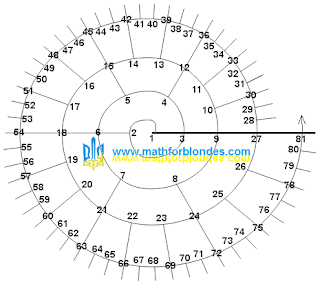

3-spiral. Number spirals. Nikolay Khyzhniak. Mathematics for blondes.
3-spiral

The main axis of the 3-spiral is formed by successive powers of the number 3. On the 3.0-turn there are two single arcs of size 180° and there are two numbers on it - these are 1 and 2 . The number of unit arcs and numbers is determined by formula (2).

The 3.1-turn is divided into six single arcs measuring 60°, on which the numbers 3, 4, 5, 6, 7 and 8 are located. The number of unit arcs and numbers is determined by formula (1). The number 6 is located on the continuation of the 2-ray and is the result of multiplying the number 2 by the number 3.

Calculations for 3-spiral. Number spirals. Nikolay Khyzhniak. Mathematics for blondes.
Calculations for 3-spiral

The 3.2-turn is formed by eighteen single arcs of size 20°, on which the numbers 9 to 26 are located.

4-spiral


4-spiral. Number spirals. Nikolay Khyzhniak. Mathematics for blondes.
4-spiral

The main axis of the 4-spiral is formed by successive powers of the number 4. On the 4.0-turn there are three single arcs of size 120° and on it there are three numbers - 1, 2 and 3.

The 4.1-turn is divided into twelve single arcs measuring 30°.

Calculations for 4-spiral. Number spirals. Nikolay Khyzhniak. Mathematics for blondes.
Calculations for 4-spiral

The 4.2-turn is divided into forty-eight unit arcs measuring 7.5°.

Each turn of the 4-helix contains two compressed turns of the 2-helix. Compression occurs unevenly and is determined by the structure of the zero turn of the 4-helix. Zero and even turns of the 2-helix are compressed to 1/3 turns of the 4-helix, the first and odd turns - to 2/3 . This uneven compression ensures that the single angular segments of all turns in the 4-helix structure are equal.

Similar uneven compression occurs on the remaining spirals, built on numbers equal to the power of the number a, greater than the first power. Thus, for an 8-helix (a=23), each turn of which contains three turns of a 2-helix, the proportions are equal: 1/7, 2/7, 4/7.

5-spiral


5-spiral. Number spirals. Nikolay Khyzhniak. Mathematics for blondes.
5-spiral

The main axis of the 5-helix is formed by successive powers of the number 5. On the 5.0-turn there are four single arcs of size 90° and on it there are four numbers - 1, 2, 3 and 4.

The 5.1-turn is divided into twenty single arcs measuring 18°.
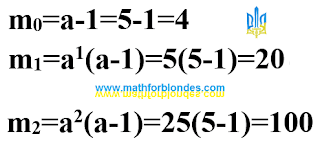
Calculations for 5-spiral. Number spirals. Nikolay Khyzhniak. Mathematics for blondes.
Calculations for 5-spiral

The 5.2-turn is divided into one hundred unit arcs of size 3.6°.

In a similar way, you can build a number spiral for any natural number.

Continued: Analysis of number spirals.

Number spirals


If you use angle units of measurement and an arbitrary spiral to visually display natural numbers, then all numbers can be ordered according to the following rules:

1. On the main axis of the a-spiral there are numbers of the form an in ascending order, where а>1, n≥0.

2. The main axis coincides with the zero ray of angle units of measurement and has the following form:

The main axis of the number spiral. Number spirals. Nikolay Khyzhniak. Mathematics for blondes.
The main axis of the number spiral

3. The main axis divides the spiral into separate turns measuring 360°, which are appropriately numbered according to the exponent of the number a located at the beginning of each turn. For example, a.0-turn, a.1-turn, a.n-turn. The distance between the turns of the spiral is arbitrary.

4. Each turn of the a-spiral is divided by rays into an equal number of single angular sectors, which divide the turn into single arcs. Each unit arc has an arbitrary length and corresponds to one numerical unit. Unit arcs separate two adjacent natural numbers, which are located at the intersections of rays and turns of the spiral.

5. The number of unit sectors and the number of natural numbers mn for each a.n-turn is determined by formula (1).

6. For zero turns of all a-spirals the number of unit sectors and natural numbers is determined by formula (2).

Number spirals formulas. Number spirals. Nikolay Khyzhniak. Mathematics for blondes.
Number spirals formulas

7. Each unit arc from a turn mn is divided into a unit arcs on the next turn mn+1 with new rays.

8. At the beginning of each ray (N-ray), at the intersection with the turn, there is a natural number N of the form Pa , prime with respect to the number a.

9. On the continuation of the N-rays, at the points of intersection with subsequent turns, there are natural numbers that are multiples of the number a, forming the main axis of the a-spiral.

Continued: Description of number spirals.

Number spirals introduction

Annotation

Number spirals are a representation of natural numbers on a spiral in units of measurement of angles. Following certain rules for placing numbers allows you to get an infinite spiral multiplication table for any natural number а>1. The appearance and structure of a particular a-spiral will be the same for any units of measurement of angles in any numeral system.

Introduction

The visual representation of natural numbers has been known for a long time and has the form of a number ray.

Number ray. Number spirals. Mathematics for blondes.
Number ray

Length units are used to visualize numbers on the number ray. The number ray starts from zero, since otherwise it is impossible to depict a unit segment as a unit of measurement. The distances between the numbers are the same and equal to a unit segment.

In 1963, Stanislaw Ulam proposed a spiral representation of the natural numbers. Today this visual representation of natural numbers is known as Ulam spiral.

Ulam spiral. Number spirals. Mathematics for blondes.
Ulam spiral

The two-dimensional plane is divided into squares of the same size. In the center of the spiral there is a unit, around it one natural number fits into each square along the spiral. This spiral was built without using any units of measurement; there is no zero.

In 1994, Robert Sacks arranged the natural numbers in an Archimedean spiral and obtained the spiral known today as the Sacks spiral (described on Wikipedia in the section "Variants").

Sacks spiral. Number spirals. Mathematics for blondes.
Sacks spiral

To construct the spiral, Sacks used angle units for rotation and length units to determine the distance from the center of the spiral to each natural number. In the center of the spiral there is a zero, without which it is impossible to depict a unit of measurement of length. On the zero ray of angle units, Sacks placed the squares of natural numbers.

Continued: Number Spirals.

Tuesday, July 12, 2016

Measurement of plane angles

Published on 7 July, 2016
"The Papers of Independent Authors"
Volume 36 of p. 43-45

Annotation

Plane angles need to be divided into trigonometrical angles and rotation angles.

Measurement of angles in a solid geometry

In a solid geometry «angle between a straight line and the plane is called angle between this line and its projection (orthogonal) to the plane. If the straight line to be a perpendicular plane, then angle between it and the plane is considered (my italic type – Nikolaj Khizhnjak) equal 90°, and between a parallel straight line and the plane – equal 0°". [1, p. 308].

As appears from definition, the angle between a straight line and the plane cannot be more than 90°. Angles more than 90° fall into to angles of rotation [2, p. 81]. In a solid geometry it is not accepted to describe by means of angles rotation of a straight line around a point of its crossing with the plane.

If the straight line is parallel to the plane (or belongs to the plane), then it is considered, that the size of the angle has zero value. Actually there is no vertex of angle – a cross point of a straight line and the plane. If the perpendicular plane straight line, then a trace turns into a point which coincides with a cross point of a straight line and the plane. Actually there is no second ray forming a angle. In this case the angle is considered right angle.

Measurement of angles in a planimetrics

On analogies to a solid geometry, a plane angle between two straight lines (line segments) it has to be measured as a angle between a point on one direct and its projection on other straight line with vertex of angle in a cross point of these straight lines.

This rule allows to divide plane angle into trigonometrical angles (from 0° to 90°) and rotation angles. The fundamental difference between these angles consists in amount of the objects on the two dimensional plane forming a angle. The trigonometrical angle is measured between two different objects, the rotation angle is measured between two provisions (initial and terminating) one object. For trigonometrical angles the time factor is absent, for rotation angles the time factor is obligatory: tentative situation, rotation time, terminating situation.

At measurement of angles between two parallel straight lines the angle cannot be defined because there is no cross point of straight lines. At measurement of a corner between two perpendicular straight lines the angle cannot also be defined because the projection of a point coincides with a cross point of these straight lines.

Conclusion: zero and right angles cannot have just the same mathematical properties as other angles. In more detail these distinctions will be described by consideration of trigonometric functions.

Angles and distances

The trigonometrical angle on the properties is similar to distance between two points, the rotation angle is similar to the passable way between the same points. If driving is carried out in a straight line, then the passable path is equal to distance between initial and terminating points of a way. If rotation is carried out on a angle to 90°, then the angle of rotation is equal to a trigonometrical angle. The rotation angle cannot be less trigonometrical angle, the passable path cannot be less than a distance between points of the beginning and end of this way. The distance between two points can be in the numerical range from zero ad infinitum. Compliance between angles from 0° to 90° and numbers from zero ad infinitum is established by a trigonometric function of a tangent of these angles.

The passable path is also expressed in the numerical range from zero ad infinitum even if the distance between an initial and finishing point of the passable way is equal to zero. In the same way the rotation angle can reach infinitely great values, at the same time the trigonometrical angle between the beginning and the end of rotation can be equal to zero. In this case it is possible to establish direct analogy between number and size of a angle as it is accepted in a calculus.

Various mathematical tools, for example, a Pythagorean theorem are used to calculation of distance between initial and terminating points of the passable path. Reduction formulas of angles are applied to definition of a angle between the beginning and the end of rotation.

Conclusion: plane angle on the properties are similar to distances on the plane.

Literature

1. Zabelyshynskaia M.Y."Mathematician. Educational and practical reference book" Kharkiv, Ranock, 2010.
2. Khizhnjak Nikolaj «Bases of mathematics», The Papers of Independent Authors, vol. 19, 2011.

P.S. This article is published for a warming up. Article about trigonometric functions in a rectangle will be a headliner of new work. I hope, from it you learn a lot of new and interesting.

Friday, March 04, 2016

What are the angles of the triangle?

Q: What are the angles of the triangle ABC, if the sum of the angles A and B is equal to 100 degrees, the sum of the angles B and C equal to 120 degrees?

The triangle and the angles. Mathematics For Blondes.
The triangle and the angles
We have two sum of two angles:

A + B = 100
B + C = 120


The sum of angles in a triangle is 180 degrees.

A + B + C = 180

Substitute in this formula the sum of two angles and find the third angle:

100 + C = 180
C = 180 - 100
C = 80


The second sum of the angles substitute angle C:

B + 80 = 120
B = 120 - 80
B = 40


The first sum of angles substitute angle B:

A + 40 = 100
A = 100 - 40
A = 60


A: The angles of the triangle are equal: A=60 degrees, B=40 degrees, C=80 degrees.

If we substitute in the second sum angles of a triangle, then the solution would be:

A + 120 = 180
A = 180 - 120
A = 60

60 + B = 100
B = 100 - 60
B = 40

60 + 40 + C = 180
C = 180 - 60 - 40
C = 80


The third variant of the decision:

We find the angle A of the first sum.

A + B = 100
A = 100 - B


We find the angle C of the second sum.

B + C = 120
C = 120 - B


Substitute the found angles to the general formula:

A + B + C = 180
(100 - B) + B + (120 - B) = 180
100 - B + B + 120 - B = 180
B - 2B = 180 - 100 - 120
-B = -40
B = 40

A = 100 - 40
A = 60

C = 120 - 40
C = 80


Conclusion: if the problem is solved correctly, the result does not depend on the method of solution.