Pages

Showing posts with label triangle. Show all posts

Sunday, March 12, 2023

Sine and cosine table

This is the most unusual table of sines and cosines. The idea to make such a table came to me in the process of writing these articles:

I strongly recommend that you read these articles. Then you will know how easy it is to calculate the values of sine and cosine yourself. I made one sine and cosine table from these three articles.

Sine and cosine table in degrees. sin and cos 0, 30, 45, 60, 90 degrees. The most unusual table of sines and cosines. Mathematics For Blondes.
Sine and cosine table


The table indicates which sides of the triangle to take as a unit. For 0 and 90 degrees, triangles do not exist, these are ordinary segments.

The third column of the table shows how to use the Pythagorean theorem to calculate the desired value of the sine or cosine. For a cosine of 30 degrees and a sine of 60 degrees, the calculations are the same.

At the bottom of the table there are hints on how to calculate the tangent and cotangent values if you know the sine and cosine values. If you forgot how to divide one fraction by another, use one more hint. You need to multiply the first fraction by the reciprocal of the second fraction.

Saturday, March 11, 2023

Sine and cosine of 45 degrees

We have already considered what the sine of 30 degrees is and what the sine of 60 degrees is equal to. Now we will see how to find the sine and cosine of 45 degrees and why they are equal.

Last time we considered an equilateral triangle. Now we will consider an isosceles right triangle. A very rare beast in a herd of triangles. Mathematicians have known it for many thousands of years, and it is simply boring for mathematicians to tinker with it.

Isosceles right triangle

We will consider a tired isosceles right triangle. Why is the triangle tired? He lay down on his side to rest.

Isosceles right triangle. Mathematics For Blondes.
Isosceles right triangle


The legs of this triangle are equal to one. Once again I repeat that both legs have the same length. We do not know the length of the hypotenuse of this triangle, but we can easily calculate it using the Pythagorean theorem.

Sine and cosine of 45 degrees

Smart people came to us and said that the sine and cosine of an angle are equal to the ratio of the legs to the hypotenuse. Since the legs of a right triangle with an angle of 45 degrees are equal, then the value of the sine of 45 degrees is equal to the value of the cosine of 45 degrees. We take the math in hand and calculate this value.

Sine and cosine of 45 degrees. Mathematics For Blondes.
Sine and cosine of 45 degrees


Why did I multiply the numerator and denominator of a fraction by the square root of two? Small children do not like lumps in porridge. Mathematicians don't like square roots in denominators. Very capricious uncles and aunts.

Friday, March 03, 2023

What is the sine of 60 degrees?

Before we look for the answer to the question: "What is the sine of 60 degrees?", I strongly recommend reading the post "Why is the sine of 30 degrees equal to half one?".

Height of an equilateral triangle

I again take an equilateral triangle with a side equal to one. I draw height.

Height of an equilateral triangle. Mathematics For Blondes.
Height of an equilateral triangle


After that, I will not turn anything. I'll just remove half of the drawing.

Cosine 60 degrees

I have a right-angled triangle, the diagonal of which is equal to one.

Cosine 60 degrees. Mathematics For Blondes.
Cosine 60 degrees


The base of this triangle is equal to 1/2 and is also equal to the cosine of an angle of 60 degrees.

Sine 60 degrees

The height of this triangle is equal to the sine of the angle of 60 degrees. We calculate the height using the Pythagorean theorem.

Sine 60 degrees. Mathematics For Blondes.
Sine 60 degrees


The sine of 60 degrees is equal to the square root of three divided by two. It is calculated in the same way as the cosine of 30 degrees.

Sunday, February 12, 2023

Why is the sine of 30 degrees equal to 1/2?

The answer to the question "why is the sine of 30 degrees equal to 1/2?" can be searched in the history of mathematics. These are ancient Mesopotamia, ancient Greece and other ancient civilizations. I am not an expert in this area. Obviously, knowledge has evolved from simpler to more complex. I will show you the most obvious answer to this question as I see it.

Equilateral triangle


Equilateral triangle. The side is equal to one. Blonde math.  Mathematics For Blondes.
Equilateral triangle


I have drawn an equilateral triangle with sides equal to one. I so want. The sum of the angles of a triangle is 180 degrees. An equilateral triangle has three 60 degree angles. I don't know trigonometry yet.

Height of an equilateral triangle


Height of an equilateral triangle. Blonde math. Mathematics For Blondes.
Height of an equilateral triangle

I drew the height in an equilateral triangle. The height is always perpendicular to the base of the triangle. If the height is drawn through the vertex of such a triangle, it will divide it into two equal right-angled triangles. This is always the case in isosceles triangles. An equilateral triangle is a special case of an isosceles triangle, in which the base is equal to the sides.

What happened as a result? The height divided the angle at the apex into two equal angles 60=30+30, it divided the base into two equal segments 1=(1/2)+(1/2). I still haven't heard anything about trigonometric functions.

Sine 30 degrees


After that, someone came up with trigonometric functions. I was told that the sine of an angle in a right triangle is the ratio of the opposite leg to the hypotenuse. How do I find the sine value for a 30 degree angle? I just flip the picture 90 degrees and remove all unnecessary.

Sine 30 degrees. Blonde math. Mathematics For Blondes.
Sine 30 degrees

The hypotenuse is equal to one. Any number divided by one does not change. So the length of the opposite leg in my triangle is equal to the sine of the angle of 30 degrees, that is, 1/2.

Cosine 30 degrees


The cosine of 30 degrees I can easily find from the Pythagorean theorem. We take the Pythagorean theorem in our hands and count.

Cosine 30 degrees. Blonde math. Mathematics For Blondes.
Cosine 30 degrees

The cosine of 30 degrees turned out to be equal to the square root of three, divided by two.

Here's how easy it is to calculate. No tables needed.

Thursday, March 02, 2017

Inverse transformations

Last time we transformed the law of cosines and a Pythagorean theorem to the sum of a line segments. Now we will execute inverse transformations.

Inverse transformations. We transformed the sum of a line segments to the law of cosines. Mathematics For Blondes.
Inverse transformations

In inverse transformations I made everything very simply. The minus sign from a formula disappeared. The problem is that we are not able to measure angles correctly. Than differ a angle 0 degrees from a angle of 180 degrees?

Measurement of a angle. 0 degree and 180 degrees. Mathematics For Blondes.
Measurement of a angle
It is possible to assume that if a line segment one, then a angle is equal 0 degrees. If a line segments two, then a angle is equal 180 degrees.

The transformations executed by us show that the mathematics has no separate areas of mathematics: "arithmetic", "algebra", "geometry" or "trigonometry". The mathematics is a single whole.

The mathematics is DNA of the nature. Further we will continue to study a cosine gene in a cosine law.

If you liked the publication and you want to know more, help me with working on by other publications.

Monday, February 27, 2017

We use the law of cosines

I was always interested in a question: how the Pythagorean theorem turns into the sum of a line segments? What I speak about? Here you look.

The Pythagorean theorem and the sum of a line segments. Mathematics For Blondes.
The Pythagorean theorem and the sum of a line segments

In geometry everything is very prime. The first time we draw a right triangle and we write down a Pythagorean theorem. The second time we draw two a line segments and we write down the sum of a line segments.

Right triangle and two a line segments. Mathematics For Blondes.
Right triangle and two a line segments

How one formula turns into other formula? To see it, we use the law of cosines. We will draw the picture, we will write down conditions, we will execute transformations.

Triangle and the law of cosines. Mathematics For Blondes.
Triangle and the law of cosines

Right triangle and the Pythagorean theorem. Law of cosines. Mathematics For Blondes.
Right triangle and the Pythagorean theorem

The law of cosines and sum of two a line segments. Mathematics For Blondes.
The law of cosines and sum of two a line segments

We use the law of cosines and turned the Pythagorean theorem into the sum of two a line segments. Further we will consider an inverse transformation.

Saturday, February 25, 2017

Law of sines

The law of sines (sine law, sine formula, or sine rule) is an equation relating the lengths of the sides of a triangle (any shape) to the sines of its angles.

The law of sines. Sine law, sine formula, or sine rule. Mathematics For Blondes.
The law of sines

Where:
a, b, c - are the lengths of the sides of a triangle;
α, β, γ - are the opposite angles;
T - are the area of triangle;
R - are the radius of the triangle's circumcircle.

How to use this monster? Use dress-making courses. Cut the law of sines on a part.


Cut the law of sines on a part. Mathematics For Blondes.
Cut the law of sines on a part

Make a necessary formula of two parts. Use properties of proportions.

Example of use of the law of sine. Mathematics For Blondes.
Example of use of the law of sine

Monday, August 01, 2016

Triangle and rectangle

Subject of occupations:
TRIGONOMETRIC FUNCTIONS IN A RECTANGLE
At the first lesson we saw off
Short analysis of trigonometric functions

Lesson 2

Transformations of a triangle to a rectangle


If to combine two rectangular triangles on diagonal so that the rectangle turned out, then the hypotenuse of a triangle will turn into rectangle diagonal, and the parties of a triangle will turn into the parties of a rectangle. The trigonometrical relations of a triangle turn into the trigonometrical relations of a rectangle.

Transformations of a triangle to a rectangle. Mathematics For Blondes.
Transformations of a triangle to a rectangle

Angular symmetry in a rectangle


Diagonal of a rectangle divides a right angle into two trigonometrical angles. The name of a trigonometric function depends on what angle we will take for definition of its numerical value. At the same time the numerical result does not depend on our choice.

Angular symmetry in a rectangle

Names of trigonometric functions and the name of angles possess properties of an angular symmetry. At the same time a symmetry of AND functions of angles are inseparably linked among themselves. If we take the symmetric function and the symmetric angle, then the result will remain invariable. We apply an angular symmetry twice. The similar situation turns out in a plane geometry. If twice to apply a reflecting symmetry, then nothing will change. In algebra analog of an angular and reflecting symmetry is multiplication to minus unit. If an algebraic expression to increase unit by minus twice, the algebraic expression will remain the same.

Reflecting symmetry, the inverse symmetry, angular symmetry, multiplication to minus unit are manifestations of the same law of a symmetry under different conditions.

Considering a symmetry of trigonometric functions, they can be united pairwise in separate groups, each of which expresses particular type of dependence between angles and numbers.

At the following lesson we will consider
Three main types of trigonometric functions

Monday, July 25, 2016

Trigonometric functions in a rectangle

Published on 7 July, 2016
"The Papers of Independent Authors"
Volume 36 of p. 46-69

Annotation

Representation of trigonometric functions in a rectangle allows to unite algebra, geometry and physics in a single whole.

Short analysis of trigonometric functions

Usually trigonometric functions of plane angle are defined in a rectangular triangle as ratios of the parties of this triangle [a reference to the source in the printing edition].

Trigonometric functions in a triangle. Mathematics For Blondes.
Trigonometric functions in a triangle

If to accept the definitions of trigonometric functions entered by mathematicians in a rectangular triangle, then values of these functions depend only on a ratio of the sizes of the parties of a triangle. The size of angles in a rectangular triangle is in the range of trigonometrical angles. Trigonometric functions have no signs and do not possess periodic. These properties are homocentrism elements.

The homocentrism mathematics is a mathematics in which the result depends on the option of the relative mathematics accepted by us or on our opinion. Striking examples of a homocentrism in mathematician are: division of numbers on positive and the negative, decimal numeration, numbers and inverse numbers, Cartesian coordinate system, etc.

In Cartesian coordinate system trigonometric functions are defined as coordinates of points of a unit circle [a reference to the source in the printing edition].

Trigonometric functions in Cartesian coordinate system. Mathematics For Blondes.
Trigonometric functions in Cartesian coordinate system

This definition is possible only because for any point of a circle of coordinate are used as padding elements for creation of a rectangular triangle. For cross points of a circle and coordinate creation of a triangle is impossible.

For any point of the plane in Cartesian coordinate system trigonometric functions can be defined as the relation of coordinates of this point or the relation of coordinates of a point to distance from a point to the center of a frame. An exception is the cross point of coordinate (the center of a frame) for which trigonometric functions cannot be defined. This fact is congenital defect of Cartesian coordinate system. If it is necessary to define trigonometric functions for the point coinciding with the center of a frame, then the frame needs to be displaced aside.

In Cartesian coordinate system trigonometric functions are the relative and depend on the relative positioning of the plane on which the considered points, and frames are located. Periodicity of trigonometric functions is result of rotation of a piece around the center of a frame. Signs of trigonometric functions depend on the positive direction of coordinate accepted by us. All this result homocentrism of views of trigonometric functions.

Signs of trigonometric functions "+" and "-" serve for orientation in space of Cartesian coordinate system. In mathematical formulas with use of trigonometric functions, the sign "minus" at function automatically changes addition for a subtraction or a subtraction on addition. In formulas it is possible to do without the negative values of trigonometric functions. It will allow to reduce twice amount of values of trigonometric functions, but will increase quantity of formulas.

At the following lesson we will consider
Transformations of a triangle to a rectangle

More interesting math ideas on the page "My Math"

Friday, April 01, 2016

Law of cosines in general

To present the law of cosines in general need to go back to the beginning. If the expression for one side of the triangle the length multiplied by the same hand n-times, the equation does not change.

Conversion formulas. Law of cosines in general. Mathematics For Blondes.
Conversion formulas

If you add equal to three sides of the triangle, we obtain the law of cosines in general.

Law of cosines in general. Mathematics For Blondes.
Law of cosines in general

The law of cosines in general terms describes the relationship between the sides and angles of a triangle in a multidimensional space. If the given equation is satisfied, then the triangle is in the Euclidean space. Options description triangle in curvilinear spaces require further study. For the correct application of the law of cosines in solid geometry, spherical triangles side length should be unit of measurement in the same units of measurement, which is measured in planimetrics.

Monday, March 28, 2016

Degenerate triangle

Finally, we will check the law of cosines to the perimeter in the degenerate triangle. There can be two options. If we decrease the base of an isosceles triangle to zero, we obtain the two overlapping segments. The sum of the angles of this degenerate triangle is 180 degrees.

Degenerate-triangle. Law of cosines to the perimeter. Mathematics For Blondes.
Degenerate triangle

If we combine the upper vertex of the triangle with the base, we get the second type of degenerate triangles. This segment equal to the sum of the other two segments. The sum of the angles are also equal to 180 degrees.

Degenerate triangle. The sum of two segments. Low of cosines. Mathematics For Blondes.
Degenerate triangle

A degenerate triangle - is the lower limit of the application of the law of cosines. After that we will look at the law of cosines in general.

Thursday, March 24, 2016

Isosceles obtuse triangle

Now we will check how the law of cosines in obtuse triangle. For example, consider an isosceles obtuse triangle.

Isosceles obtuse triangle. Law of cosines. Mathematics For Blondes.
Isosceles obtuse triangle

Ups! The perimeter of the triangle may be square roots. The law of cosines is not working? Do not jump to conclusions. The secret is revealed very simple. Let us express the base of the triangle through the sides and see what happens. Double-paste the resulting equation in our result. First time turvy-topsy, second time topsy-turvy.

The perimeter of the triangle. Mathematics For Blondes.
The perimeter of the triangle

The law of cosines to the perimeter works flawlessly. We have completed our review of the degenerate triangle.

Wednesday, March 16, 2016

Right triangle

Now we will check the law of cosines to the perimeter of the example of a right triangle. At one corner of the right triangle is 90 degrees, the cosine of this angle is zero. Cosine of the other angles are obtained by dividing the length of the hypotenuse to the length of the adjacent side. In general, the law of cosines check looks like.

Right triangle. Law of cosines to the perimeter. Mathematics For Blondes.
Right triangle

Now we substitute in formula for the length of the sides of a right triangle and values of cosines.

Right triangle. Mathematics For Blondes
Right triangle

These values are equal to the perimeter of the triangle. Cosine law allows to check the triangle on the break. That's what happens when one of the sides does not reach the top of the triangle.

Broken triangle. Mathematics For Blondes.
Broken triangle

Equality is performed, but the result is not equal to the sum of the lengths of a broken line or the perimeter of the triangle. You can then proceed to test the law of cosines in the isosceles obtuse triangle.

Tuesday, March 15, 2016

Check the law of cosines

Check the law of cosines for the perimeter, we start with an equilateral triangle. All sides of an equilateral triangle are equal. All angles are equal to 60 degrees. The perimeter of the triangle is equal to three times the length of the sides.

Equilateral triangle. Check the law of cosines. Mathematics For Blondes.
Equilateral triangle

Equality is performed. Now we check the law of cosines in a right triangle.

Monday, March 14, 2016

Law of cosines for perimeter

Carefully look at the proof of the law of cosines and make some corrections.

Analysis of proof. Law of cosines and perimeter. Mathematics For Blondes.
Analysis of proof

Now we can write the law of cosines for the perimeter of the triangle.

Law of cosines for perimeter. Perimeter of triangle. Mathematics For Blondes.
Law of cosines for perimeter

The result is a very simple and beautiful formula that describes the entire triangle. The law of cosines shows a relationship between the angles and the lengths of the sides of a triangle.

The geometry of the law of cosines. Triangle. Mathematics For Blondes.
The geometry of the law of cosines

Law of cosines for perimeter describes the perimeter of the triangle made up of one-dimensional Euclidean spaces. For multidimensional spaces cosine law has a different view.

Sunday, March 13, 2016

Law of cosines

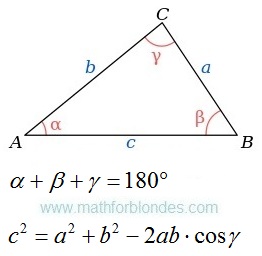
The triangle has three sides and three corners. Appearance cosine theorem depends on the received angles and sides of the triangle symbols. Here's how it looks in Wikipedia.

Law of cosines. The triangle has three sides and three corners. Mathematics For Blondes.
Law of cosines

Three angle of the triangle gives three options for the formula of one triangle. In law of cosines can use a one formula, and three variants of symbols.

Three variants of symbols. Law of cosine for triangle. Mathematics For Blondes.
Three variants of symbols

These two options allow to describe all sides and angles of the triangle. The traditional problems of mathematics we are taught to find one of the triangle elements.

Question: Can one formula with one variant of symbols to describe all the elements of the triangle?

Answer: Yes, you can.
Here's how to do it using the cosine theorem.

The proof of the theorem of cosines in the trigonometric form looks like.

The proof using trigonometry. The proof law of cosines. Mathematics For Blondes.
The proof using trigonometry

If you change the "minus" sign in the "plus" sign, we get the cosine theorem for the perimeter of the triangle.

Law of cosines in general form (in Russian).

Friday, March 04, 2016

What are the angles of the triangle?

Q: What are the angles of the triangle ABC, if the sum of the angles A and B is equal to 100 degrees, the sum of the angles B and C equal to 120 degrees?

The triangle and the angles. Mathematics For Blondes.
The triangle and the angles
We have two sum of two angles:

A + B = 100
B + C = 120


The sum of angles in a triangle is 180 degrees.

A + B + C = 180

Substitute in this formula the sum of two angles and find the third angle:

100 + C = 180
C = 180 - 100
C = 80


The second sum of the angles substitute angle C:

B + 80 = 120
B = 120 - 80
B = 40


The first sum of angles substitute angle B:

A + 40 = 100
A = 100 - 40
A = 60


A: The angles of the triangle are equal: A=60 degrees, B=40 degrees, C=80 degrees.

If we substitute in the second sum angles of a triangle, then the solution would be:

A + 120 = 180
A = 180 - 120
A = 60

60 + B = 100
B = 100 - 60
B = 40

60 + 40 + C = 180
C = 180 - 60 - 40
C = 80


The third variant of the decision:

We find the angle A of the first sum.

A + B = 100
A = 100 - B


We find the angle C of the second sum.

B + C = 120
C = 120 - B


Substitute the found angles to the general formula:

A + B + C = 180
(100 - B) + B + (120 - B) = 180
100 - B + B + 120 - B = 180
B - 2B = 180 - 100 - 120
-B = -40
B = 40

A = 100 - 40
A = 60

C = 120 - 40
C = 80


Conclusion: if the problem is solved correctly, the result does not depend on the method of solution.

Monday, February 15, 2016

Find the angles of an isosceles triangle

Find the angles of an isosceles triangle if the angle opposite the base, at 24 degrees less than the angle at the base of the triangle.

The triangle is isosceles. In an isosceles triangle the angles at the base are equal. The sum of the angles of a triangle is 180 degrees.

Let the angle at the base through X. Then the angle opposite the base, is equal to X-24. We write the formula for the sum of angles of a triangle and find the X:

2х+х-24=180
3х=180+24
х=204/3
х=68


Now we find the third angle:

х-24=68-24=44

Make a check:

2*68+44=136+44=180

Answer: the corners of triangle are equal to 68, 68 and 44 degrees.

Monday, April 20, 2015

Stupid triangle top view

Maybe it's someone not very pleasant, but stupid triangles does not happen, there are only stupid people. But wits on the Internet are often looking for a stupid triangle, top view which they would very much like to see. Show.

Stupid triangle top view. Obtuse triangle. Mathematics for blondes.
Stupid triangle top view

First, let's talk about the name of this type of triangles. Call similar triangles stupid - a sign of illiteracy. As they say now, "politically correct" will call such triangles "obtuse". All the triangles which have one angle greater than 90 degrees, are obtuse triangle. It's not a shame, is not a defect, just that physique is obtuse triangles. However, each obtuse triangle always has a couple of sharp corners. So, just in case.

Now let's talk about the kinds. No triangles on the kinds and types of top side of the window. Obtuse triangle top looks exactly the same as the bottom. But the side view is not pleasing to the eye - is just a regular interval. From the window you are unlikely to consider anything, but in a notebook at a neighbor's party this triangle you can see from many angles. In this case the obtuse triangle will look quite different, what it looks like from above. Describe such a wonderful transformation is possible by means of projective geometry, descriptive geometry, trigonometry, or poems. Who like more.

Saturday, January 31, 2015

Two angles of a triangle

Consider a very basic problem about two angles of a triangle are known. This problem sounds like this:

Two angles of a triangle are 53 degrees and 57 degrees. Find it the third corner of the triangle.

In any triangle all three angles. That is why the triangle is called. The value of the two angles of the three we know. Now I ask you a couple questions that will help solve this problem.

The first question. What is the sum of the angles of a triangle? This sacred knowledge of mathematics tease "A theorem on the sum of the angles of a triangle." As if they did not call it a law of nature, its essence does not change. Incidentally, the sum of the angles of a triangle belongs to the category of the mathematical knowledge that is easily stored for a long time, but that you never use not awake in their daily lives. Useless knowledge? No, but people use this knowledge is very limited range of professions, such as surveyors.

Sum of the angles of a triangle. The sum of three angles of a triangle is 180 degrees. Mathematics for blondes.
Sum of the angles of a triangle


The second question. If you know that the sum of all the angles of a triangle is 180 degrees, with the arithmetic yourself cope? Here everything is simple. From the sum of the angles of a triangle 180 degrees subtract two prominent corner and get the value of the third angle of the triangle.

180 - 53 - 57 = 70 degrees

I do not want to show here ready-made solution, but ... First, the calculator have a lot of different buttons and accidentally be confused. In such cases, the scientists disappear satellites of Mars. So a complete solution for monitoring, can not hurt. Just check yourself.

Secondly, this is a very good opportunity to do what we do mathematics is strongly not recommended. We are taught to perform tasks with minimal downtime, and possibly without saving intermediate results. Actually, I did. On the one hand, it is correct. On the other hand, it does not give us the opportunity to understand, but what do we actually do?

Personally, I like to consider solving mathematical problems under the microscope in slow motion. Sometimes the impression is that we observe the focus by illusionist and all the secrets of the focus immediately crawl out. Let's look at the detailed solution of this problem on two well-known corners of the triangle and one unknown. Here's how it looks.

Two angles of a triangle. Solution of the problem. Mathematics for blondes.
Two angles of a triangle

And so. Someone measured the angles in a triangle is real. The measurements were performed only for the two corners. Man in high school and knows that the third angle can be simply calculated. This is the condition of the problem. Now, a detailed description of the meaning of the decision and the action carried out by us.

1. Write a law that establishes a relationship between the angles of a triangle, in algebraic form. I have already said that in mathematics it is called "A theorem on the sum of the angles of a triangle." The geometric shape of this law is shown in the first picture.

2. Transform the algebraic form of the law on the corners of a triangle to solve our specific problem.

3. Enter this formula in the data from the task ahead of us. Pass from the algebraic form to the physical.

4.Analiziruem physical model for solving the problem. Mathematical apparatus introduced the decimal system of numbers, other notations are absent. The physical device is represented by a measure of the degree angles, other angle units available. Only under these conditions we can perform addition and subtraction.

5. Go to the mathematical model of the physical problem and perform mathematical operations with numbers using a calculator, a sheet of paper or in your mind.

6. Get ready solution to the problem in physical form.

Here's a novel in verse about I turned to a very simple task. The accuracy of the description of this literary opus does not claim because the school did not teach me this, had to invent on the fly. All the described actions we perform automatically, without going into detailed explanations. I agree with mathematicians that stupid every solution of the problem in as much detail paint. But even more stupid stupid to perform the actions that you teach. In this case, the formation is converted into a conventional animal training.